

What I Read This Year
A list of books and essays in the world of scholarship that changed my thinking and writing in 2025

Dear readers,
I’m a big supporter of year-end inventories.
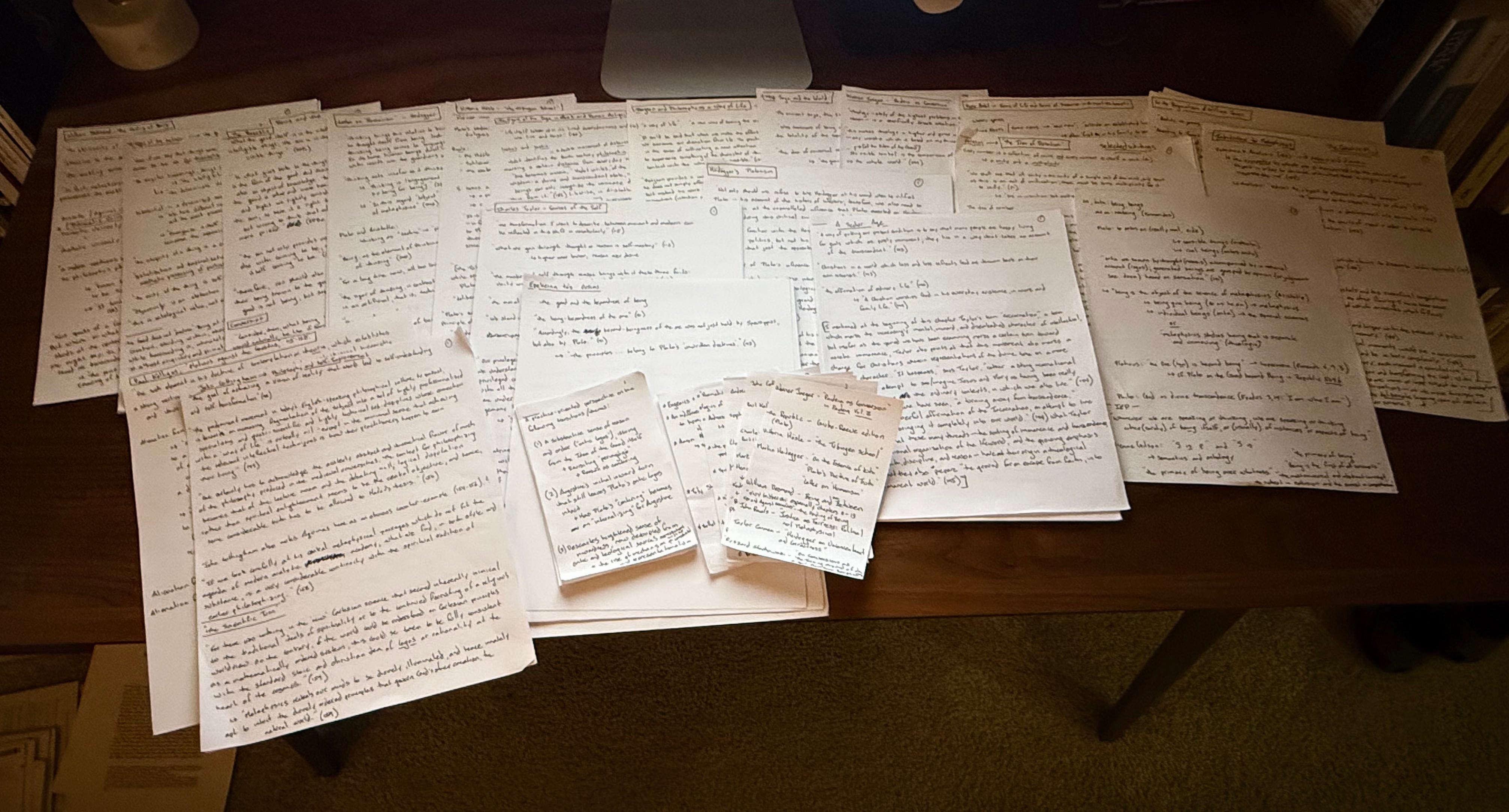
One inventory I especially like to do is take a look back at all of the essays, articles, and books I read over the past year. I find it gives one an aerial view of where one’s research and writing has been going, and where it should go, in the future.
In that spirit, I thought this year I would share with you all a mostly complete (but not exhaustive) list of the pieces that genuinely reshaped my thinking in 2025.
There are primary and secondary sources here, works new to me and revisited, both recently published and older texts alike.
I had two criteria for inclusion: (1) Did the work change my understanding of something important? or (2) Did this work make its way into something I’d written, am currently working on, or presented as part of a talk?
If you’ve been following along with my output over the past year, you’ll see some familiar listings below, but there are also a number of sources included here that have shaped my work in more subtle ways, and those are included, too.
What’s the point in sharing this?
Well, if you liked the essays and talks I posted in 2025, you may be interested in the source material. And that’s what you’ll find below, organized around these general topics and themes (with links included):
Phenomenology, perception, and attention
Plato, Aristotle, and the classical question of the Good
Late antiquity, mind–body questions, and Plotinus
Heidegger on truth, correctness, and Plato
Bergson on duration and metaphysics
Philosophy as spiritual exercise and formation
Memory, perception, and ontology
Aesthetics, form, and practice
William Desmond’s philosophy
Modern identity, secularity, and public reason
If I had thought about it more in advance, I would have kept a running catalogue of all the good online essays I read this year, especially the shorter pieces that don’t naturally land in a bibliography. That will be a goal for 2026.
For now, below is the core of what mattered to me in the world of scholarship in 2025.
I hope you all have a great new years, and I’ll see you in 2026.
Best wishes,
Adam
Phenomenology, perception, and attention
Maurice Merleau-Ponty. “In Praise of Philosophy.”
Maurice Merleau-Ponty. Phenomenology of Perception (esp. ch. 3 “Attention and Judgment” and ch. 11 “The Cogito”).
William James. The Principles of Psychology, Vol I (esp. on attention).
Eleanor Gibson and Nancy Rader. “Attention: The Perceiver as Performer”
Evan Thompson. Mind in Life: Biology, Phenomenology, and the Sciences of Mind.
Evan Thompson. Waking, Dreaming, Being: Self and Consciousness in Neuroscience, Meditation, and Philosophy.
Iain McGilchrist. The Master and His Emissary: The Divided Brain and the Making of the Western World.
Byung Chul-Han. The Disappearance of Rituals.
Plato, Aristotle, and the classical question of the Good
Plato. The Republic (Grube–Reeve ed.).
Andrea Nightingale. “‘Useless’ Knowledge: Aristotle’s Rethinking of Theōria” (in Spectacles of Truth in Classical Greek Philosophy: Theōria in Its Cultural Context).
Rafael Ferber and Gregor Damschen. “Is the Idea of the Good Beyond Being? Plato’s ‘epekeina tês ousias’ revisited (Republic 6, 509b8–10).”
Gerhard Seel. “Is Plato’s Conception of the Form of the Good Contradictory?”
Andrew S. Mason. “The Good, Essences, and Relations.”
Carl Séan O’Brien. Plato’s Unwritten Doctrines.
Vittorio Hösle. “The Tübingen School.” (in Brill’s Companion to German Platonism).
Ryszard Stachowski. “On Conversion as ‘The Turning around of a Soul from Some Benighted Day’ (Plato).”
Werner Jaeger. Paideia, vol. II (esp. the section “Paideia as Conversion”).
Lloyd P. Gerson. From Plato to Platonism.
Eric Perl. Thinking Being: Introduction to Metaphysics in the Classical Tradition.
Late antiquity, mind–body questions, and Plotinus
Sophie Cartwright. “Soul and Body in Early Christianity: An Old and New Conundrum” (in A History of Mind and Body in Late Antiquity).
Paul Kalligas. “Plotinus Against the Gnostics.”
Heidegger on truth, correctness, and Plato
Martin Heidegger. “On the Essence of Truth” (in Pathmarks).
Martin Heidegger. “Plato’s Doctrine of Truth” (in Pathmarks).
Martin Heidegger. “Letter on ‘Humanism’” (in Pathmarks).
Taylor Carman. “Heidegger on Unconcealment and Correctness.”
Jussi Backman. “All of a Sudden: Heidegger and Plato’s Parmenides.”
Mark Ralkowski. Heidegger’s Platonism.
Bergson on duration and metaphysics
Henri Bergson. “The Idea of Duration” (in Key Writings).
Henri Bergson. “Introduction to Metaphysics” (in The Creative Mind).
Henri Bergson. “Introduction II” (in The Creative Mind).
Henri Bergson. “On the Pragmatism of William James” (in The Creative Mind).
Keith Ansell-Pearson. “Bergson and Philosophy as a Way of Life.”
Philosophy as spiritual exercise and formation
Pierre Hadot. “Forms of Life and Forms of Discourse in Ancient Philosophy.”
Pierre Hadot. “The Sage and the World” (in Philosophy as a Way of Life).
Pierre Hadot. “The Figure of the Sage in Greek and Roman Antiquity” (in The Selected Writings of Pierre Hadot).
John Cottingham. “Philosophy and Self-Improvement: Continuity and Change in Philosophy’s Self-conception from the Classical to the Early-modern Era” (in Philosophy as a Way of Life: Ancients and Moderns: Essays in Honor of Pierre Hadot).
John Cottingham. Cartesian Reflections: Essays on Descartes’s Philosophy.
Simone Weil. “Reflections on the Right Use of School Studies with a View to the Love of God.”
Charles M. Stang. “Writing” (in The Cambridge Companion to Mysticism).
Memory, perception, and ontology
Mary Carruthers. The Book of Memory: A Study of Memory in Medieval Culture.
Frances A. Yates. The Art of Memory.
Henri Bergson. Matter and Memory (excerpt in Key Writings).
Aesthetics, form, and practice
Gabriel Trop. Poetry as a Way of Life: Aesthetics and Askesis in the German Eighteenth Century.
Jan Zwicky. “Introduction. What is Gestalt Thinking?” (in The Experience of Meaning).
Goethe. “Dialogical Knowing. Excerpts from Goethe’s Writings.”
Steve Talbott. “How Does an Organism Get Its Shape?”
Josef Pieper. Only the Lover Sings: Art and Contemplation.
Josef Pieper. Leisure: The Basis of Culture.
William Desmond’s philosophy
William Desmond. Being and the Between (esp. chs. 8–13; “Things,” “Intelligibilities,” “Selves,” “Communities,” “Being True,” and “Being Good”).
William Desmond. “Flux-Gibberish: For and Against Heraclitus.”
William Desmond. The Voiding of Being: The Doing and Undoing of Metaphysics in Modernity.
William Desmond. The Gift of Beauty and the Passion of Being: On the Threshold between the Aesthetic and the Religious.
Modern identity, secularity, and public reason
Charles Taylor. Sources of the Self: The Making of the Modern Identity (esp. Part II “Inwardness”: “Moral Topography,” “Plato’s Self-Mastery,” “In Interiore Homine,” and “Descartes’s Disengaged Reason”).
Charles Taylor. A Secular Age (esp. Part I “The Work of Reform”; “Modern Social Imaginaries”; and selected readings on “excarnation”).
John Rawls. “Justice as Fairness: Political not Metaphysical.”
Too bad you didn’t get around to anything more serious this year.
🥸
Wow, what a great list! I’m wanting to read Iain McGilchrist this year.
Here’s what I’m currently reading:
https://open.substack.com/pub/andrew756864/p/what-im-reading-and-why-january-2026?r=fx017&utm_medium=ios&shareImageVariant=overlay